7. The Determinant and Inverse of Matrix
The Determinant of a Square Matrix (矩阵的行列式)
The determinant is defined only for square matrices. For a matrix , the determinant of , denoted as , is a scalar value.
For matrix
the determinant of can be denoted as
Computation of the Determinant
For a matrix , the determinant is computed as:
For a matrix , the determinant is computed as:
that is,
For any square matrix , let be the matrix obtained by deleting the -th row and -th column of . For example, for the above matrix , we have , , and .
Then we can compute the determinant of by expanding along the first row as follows:
Specifically, if is a triangular matrix, then the determinant of is the product of the entries on the main diagonal of . That is,
Rules of the Determinant
- If is a square matrix and is obtained from by interchanging two rows, then .
- If is a square matrix and is obtained from by multiplying a row of by a nonzero scalar , then .
- If is a square matrix and is obtained from by adding a scalar multiple of one row of to another row, then .
- , where is a scalar.
- , and for any positive integer .
- if is invertible.
- is NOT equal to in general.
Geometric Interpretation of the Determinant
Area and Volume Scaling Factor
The determinant of a square matrix can be interpreted as the scaling factor of the linear transformation represented by the matrix. Specifically, if is an matrix, then the absolute value of represents how much the volume of a unit cube in is scaled when transformed by . If , it means that the transformation collapses the space into a lower dimension, and thus the volume is reduced to zero.
Computing the Area or Volume of a Parallelogram
For a matrix , gives the area of the parallelogram formed by the column vectors of .
For a matrix , gives the volume of the parallelepiped formed by the column vectors of .
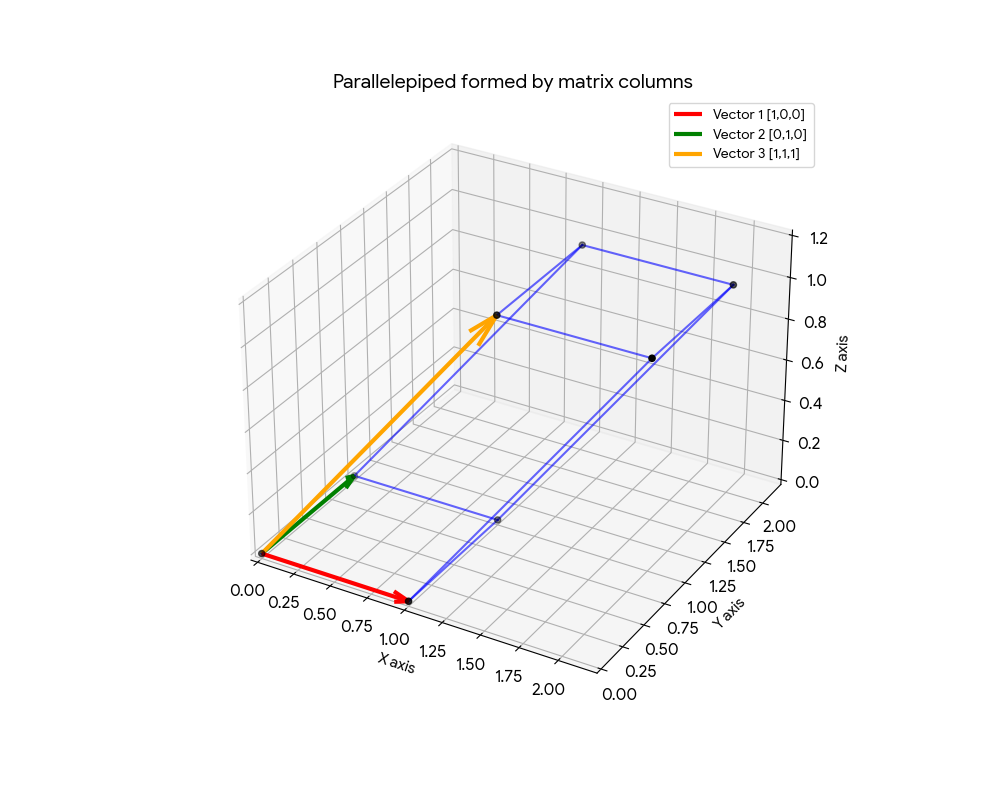
The column vectors of a matrix can be thought of as the edges of a parallelogram (in 2D) or a parallelepiped (in 3D) that connects the origin to the adjacent vertices (相邻顶点). Note that the origin is also one of the vertices of the parallelogram or parallelepiped.
For example, for the matrix , the column vectors are , , and , and the parallelepiped formed by these three vectors looks like this:
The Inverse of a Square Matrix (矩阵的逆)
Definition
For a square matrix , if there exists a matrix such that , then we call the inverse of , denoted as , and we say that is invertible.
A matrix is invertible if and only if its determinant is nonzero.
A matrix that is NOT invertible is called a singular matrix, and a matrix that is invertible is called a nonsingular matrix.
Info
For a matrix , if , then is invertible and
The inverse of a matrix has the following properties:
- If is invertible, then is also invertible and .
- For invertible matrices, , , etc.
- If is invertible, then is also invertible and .
Finding the Inverse of a Matrix
An matrix is invertible if and only if is row equivalent to the identity matrix . And in this case, we can find by performing the same row operations on .
As a result, we can find by row reducing the augmented matrix to the form .